

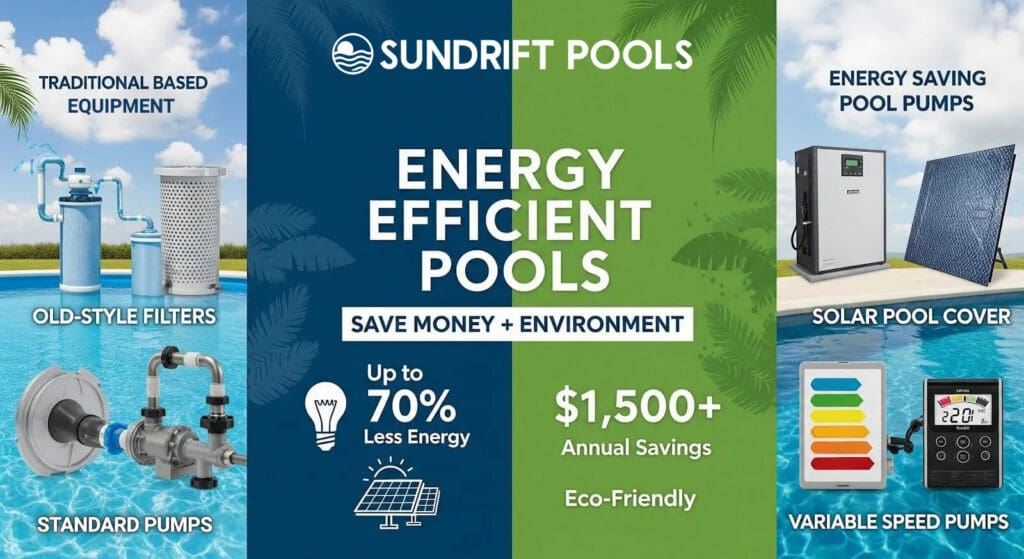
After installing thousands of pool systems across South Carolina over the past fifteen years, I’ve witnessed a remarkable transformation in energy-efficient pool equipment SC technology. Last year alone, I helped a Greenville family reduce their pool energy costs by $1,800 annually by upgrading to modern, efficient equipment – savings that paid for the upgrades in less than three years.
The evolution of energy-efficient pool equipment SC has accelerated dramatically, driven by both environmental concerns and rising energy costs. What once seemed like expensive “green” alternatives have become standard recommendations because the financial benefits are so compelling. I regularly show families energy bills that dropped 60-70% after equipment upgrades.
Let me share what I’ve learned about energy-efficient pool equipment SC from actual installations, energy audits, and tracking long-term performance across hundreds of South Carolina pools. The savings are real, the technology is proven, and the environmental benefits are substantial.
Before diving into specific equipment recommendations, it’s important to understand how South Carolina’s climate affects pool energy consumption and why energy-efficient pool equipment in SC makes such a significant difference here.
South Carolina pools operate longer seasons than northern climates, meaning equipment runs 8-9 months annually compared to 4-5 months in colder regions. This extended operating season amplifies both energy consumption and potential savings from efficient equipment.
Our high humidity levels also affect energy consumption patterns. Pump systems work harder to maintain circulation in humid conditions, while heaters cycle more frequently to maintain comfortable temperatures during our variable spring and fall weather.
Summer energy costs in South Carolina are particularly problematic because pool usage peaks during the same periods when electrical demand and rates are highest. I’ve seen July electric bills exceed $400 monthly for pools with older, inefficient equipment.
Modern energy-efficient pool equipment SC systems reduce peak demand through intelligent controls that shift operation to off-peak hours and variable-speed technology that reduces overall consumption during high-cost periods.
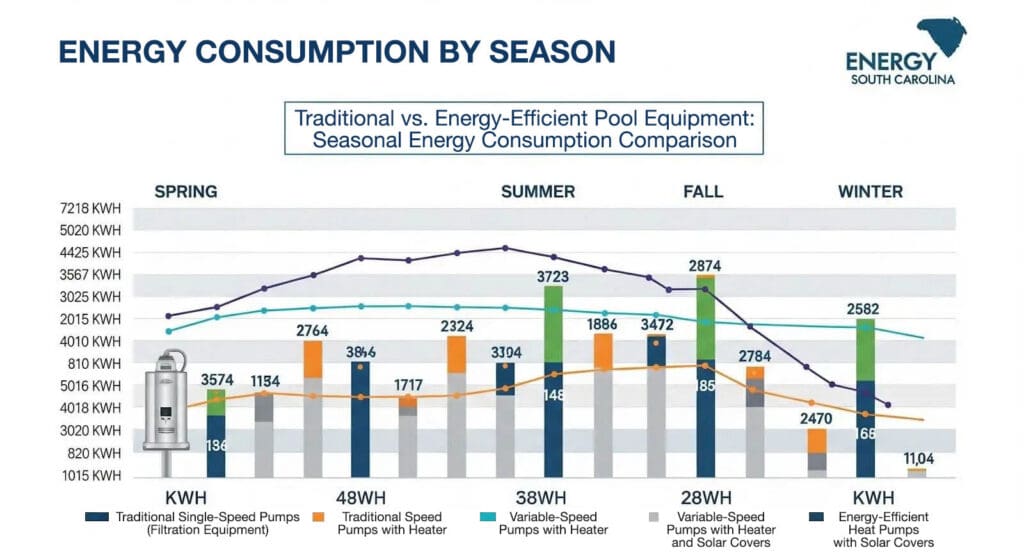
Variable speed pumps represent the single most impactful upgrade in energy-efficient pool equipment SC technology. After installing hundreds of these systems, I can confidently say they provide the fastest payback and most dramatic energy savings of any pool equipment upgrade.
Traditional single-speed pumps operate at full power whenever running, consuming 2,500-3,500 watts continuously. Variable speed pumps adjust motor speed to match actual circulation needs, typically operating at 600-1,200 watts for routine circulation.
The energy savings follow cubic relationships to speed reductions. Running a pump at half speed uses only one-eighth the energy while still providing adequate circulation for most pool maintenance functions. This mathematical relationship creates dramatic energy reductions.
I recently completed an energy audit for a Spartanburg family with a traditional 2-horsepower pump that consumed 2,800 watts. After installing a variable speed replacement, their pump consumption dropped to an average of 800 watts a 71% reduction that saved $1,400 annually at current energy rates.
The family was amazed that their pool remained perfectly clean and balanced despite the dramatic energy reduction. Proper programming ensures adequate circulation while maximizing efficiency.
Successful variable speed pump installation requires proper programming that balances energy efficiency with pool maintenance needs. I typically program three-speed schedules: low speed for overnight circulation, medium speed for daily filtration, and high speed for equipment operation and cleaning.
South Carolina’s extended pool season means programming adjustments are necessary as temperatures and usage patterns change. Spring and fall programming emphasizes efficiency, while summer schedules prioritize performance during peak use periods.
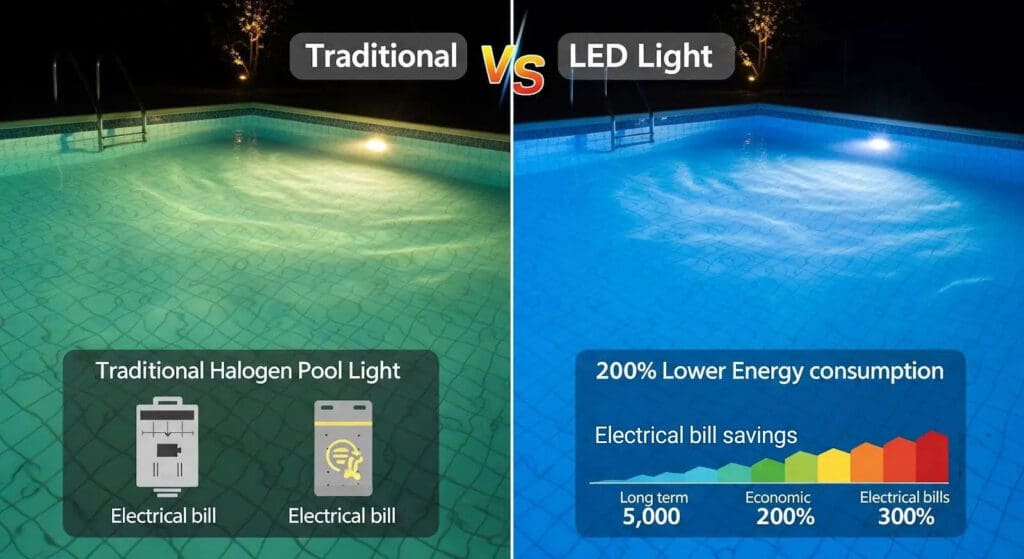
Modern LED pool lighting represents another area where energy-efficient pool equipment SC technology provides both immediate and long-term benefits. The transformation from traditional incandescent systems to LED technology offers dramatic energy savings combined with enhanced functionality.
Traditional 500-watt incandescent pool lights consume substantial energy, especially for families who enjoy evening swimming. LED replacements typically consume 20-40 watts while providing equivalent or superior illumination.
I recently calculated lighting savings for a family with six traditional pool lights. Their monthly lighting energy costs dropped from $85 to $12 after LED conversion – savings of $876 annually with improved color options and control functionality.
Modern LED systems offer color-changing capabilities, smartphone control, and programming options that weren’t possible with traditional lighting. These features enhance pool enjoyment while consuming minimal energy.
The programming capabilities allow families to create lighting schedules that provide security illumination using minimal energy while reserving full lighting for entertaining and swimming activities.
LED pool lights typically last 15-20 years compared to 1-2 years for traditional bulbs. This longevity reduces replacement costs and maintenance frequency while providing consistent performance throughout their service life.
In South Carolina’s heat and humidity, LED reliability becomes particularly important. I’ve seen traditional pool lights fail frequently during the summer months when replacement is most disruptive to family enjoyment.
Solar pool heating represents one of the most environmentally beneficial and cost-effective applications of energy-efficient pool equipment SC technology. South Carolina’s abundant sunshine and extended pool seasons create ideal conditions for solar heating performance.
South Carolina receives 250+ sunny days annually, providing excellent solar energy potential for pool heating. Properly designed solar systems can extend swimming seasons by 2-3 months while eliminating traditional heating costs.
I’ve installed solar systems that provide 100% of heating needs from March through November, with only occasional backup heating required during cloudy periods or unusual cold snaps. The fuel cost elimination creates substantial annual savings.
Effective solar pool heating requires proper system sizing based on pool surface area, typical temperature goals, and local solar conditions. I typically recommend solar collector areas equal to 80-100% of pool surface area for optimal performance.
Installation orientation and angle optimization maximize solar energy capture throughout South Carolina’s varying sun angles. Proper design ensures consistent performance from early spring through late fall swimming seasons.
Solar pool heating systems typically cost $8,000-$15,000 installed, depending on pool size and system complexity. With traditional heating costs of $1,500-$3,000 annually in South Carolina, payback periods range from 4-8 years.
After payback completion, solar systems provide essentially free pool heating for their 15-20 year service life. This long-term savings potential makes solar heating one of the most financially attractive energy-efficient pool equipment SC upgrades.
For families preferring conventional heating systems, modern heat pumps provide significantly better efficiency than traditional gas or electric resistance heaters while maintaining reliable performance.
Heat pumps extract ambient heat from air rather than generating heat directly, achieving 300-500% efficiency compared to 80-95% for traditional heaters. This efficiency advantage creates substantial operating cost savings.
In South Carolina’s moderate climate, heat pumps operate efficiently throughout most of the swimming season. Even during cooler periods, modern units maintain good performance down to 45-degree ambient temperatures.
I recently compared operating costs for different heating systems on identical pools. Traditional gas heating costs $2,800 annually, electric resistance heating costs $3,200, while heat pump heating costs only $1,100 for the same temperature maintenance.
These operating cost differences compound over equipment lifetime, making heat pumps increasingly attractive despite higher initial installation costs.

Modern automation systems represent the “brain” of energy-efficient pool equipment SC installations, coordinating all equipment operation to maximize efficiency while maintaining optimal pool conditions.
Automation systems optimize pump speeds, heating schedules, and cleaning cycles to minimize energy consumption while ensuring proper pool maintenance. Smart programming shifts energy-intensive operations to off-peak hours when electricity rates are lower.
I program automation systems to reduce pump speeds during heating cycles, coordinate equipment operation to avoid peak demand charges, and adjust schedules based on seasonal usage patterns.
Smartphone connectivity allows homeowners to monitor energy consumption, adjust settings, and optimize operation from anywhere. This real-time control helps families maximize efficiency while maintaining comfort and convenience.
Energy monitoring features help families understand consumption patterns and identify opportunities for additional savings through operational adjustments.
Advanced automation systems learn from usage patterns and automatically adjust operations to optimize efficiency. These systems can reduce energy consumption by 15-25% beyond basic automation through intelligent learning algorithms.
South Carolina offers several rebate and incentive programs that improve the financial attractiveness of energy-efficient pool equipment SC upgrades.
Duke Energy and other South Carolina utilities offer rebates for variable speed pumps, LED lighting, and heat pump installations. Current rebates range from $200-$800 per qualifying equipment installation.
I help families navigate rebate applications and ensure equipment meets program requirements. Proper documentation and installer certification are essential for rebate approval.
Solar pool heating systems may qualify for federal tax credits that cover 30% of installation costs. These credits can save thousands of dollars on larger solar installations while supporting renewable energy adoption.
Heat pump installations may also qualify for tax credits or deductions, though program availability and requirements change periodically.
Many utility companies offer special financing for energy efficiency upgrades, including pool equipment. These programs often provide below-market interest rates that improve project economics.
Beyond financial benefits, energy-efficient pool equipment SC upgrades provide substantial environmental benefits that matter to increasingly eco-conscious homeowners.
Energy-efficient equipment reduces carbon emissions through lower electricity consumption. A typical equipment upgrade can reduce pool-related emissions by 3-5 tons of CO2 annually – equivalent to taking a car off the road for 7,000-12,000 miles.
Solar heating systems provide even greater environmental benefits by eliminating fossil fuel consumption for pool heating.
Variable speed pumps and efficient filtration reduce water consumption through better circulation and filtration performance. Improved water quality means less frequent backwashing and chemical usage.
LED lighting eliminates toxic mercury found in some traditional pool lights while providing longer service life that reduces replacement waste.

After installing and servicing equipment from dozens of manufacturers, I’ve developed strong preferences for brands that combine performance, reliability, and efficiency.
Pentair IntelliFlo and Hayward TriStar series pumps consistently provide excellent performance and reliability. Both brands offer robust warranties and have proven track records in South Carolina’s challenging climate.
I’ve had excellent experience with Jandy FloPro series pumps for budget-conscious installations. While lacking some premium features, they provide reliable efficiency gains at lower initial costs.
Pentair IntelliBrite and Hayward ColorLogic systems offer excellent performance and reliability. Both provide smartphone control, color programming, and energy efficiency with proven longevity.
Hayward HeatPro and Pentair UltraTemp series heat pumps provide excellent efficiency and reliability. Both brands offer titanium heat exchangers that resist corrosion in South Carolina’s humid environment.
Successful energy-efficient pool equipment SC upgrades require careful planning that considers current equipment condition, energy costs, and family priorities.
Families can implement efficiency upgrades incrementally, starting with the highest-impact items like variable speed pumps and progressing through other equipment as budgets allow.
Proper installation and programming are critical for achieving projected energy savings. DIY installations often fail to deliver expected benefits due to programming errors or installation problems.
Energy-efficient pool equipment SC technology has matured to the point where upgrades make financial sense for virtually every pool owner. The combination of lower operating costs, rebate availability, and environmental benefits creates compelling value propositions.
Working with experienced professionals who understand both the technology and local conditions ensures optimal performance and maximum savings from your efficiency investments. The upfront costs are recovered quickly through energy savings, while long-term benefits provide value for years to come.